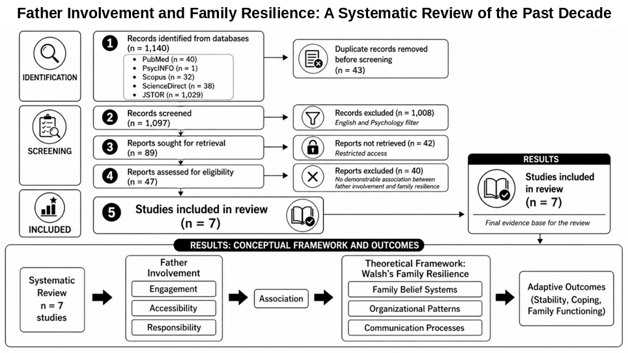
The objective of this systematic review was to identify, evaluate, and synthesize empirical psychological studies that examined the relationship between father involvement and family resilience. A systematic review design that was guided by PRISMA was implemented. The study population was composed of full-text psychology articles in English that were indexed in PubMed, PsycINFO, Scopus, ScienceDirect, and JSTOR. The literature search was conducted on December 22, 2024, and it encompassed publications from January 2014 to December 2024. Seven eligible studies were selected from 1,140 records through duplicate removal, predefined inclusion and exclusion criteria, full-text eligibility assessment, and methodological quality appraisal. The sample contained these studies. Purposive screening was implemented to identify studies that were pertinent to father involvement, family resilience, and acceptable methodological quality. These instruments comprised Walsh’s family resilience framework, the Critical Appraisal Skills Program checklist, and the PRISMA flow framework. Organizational patterns, communication processes, and family belief systems were employed to guide thematic narrative synthesis in the analysis of data. There was no meta-analysis conducted, so statistical software was not employed. The results indicated that father involvement was positively associated with family resilience through adaptive family organization, supportive communication, shared meaning-making, and stability during crises. The review concludes that fathers should be incorporated into family-based interventions, clinical practice, and future psychological research as active relational resources that enhance adaptive functioning across diverse families.
جوادی، ف.، حسن زاده، سعید.، افروز، غلامعلی.، و قاسم زاده، سوگند. (1399). تأثیر برنامه درمانی مبتنی بر تعامل والد کودک (PCIT) بر رابطه خانواده با کودکان دارای اختلال طیف اُتیسم. فصلنامه پژوهشهای کاربردی روانشناختی، 11(3)، 54-37.https://doi.org/10.22059/japr.2020.265071.642963
Ajzen, I., & Fishbein, M. (1980). Understanding attitudes and predicting social behavior. Englewood Cliffs, NJ: Prentice Hall
Bagner, D. M., & Eyberg, S. M. (2010). Father involvement in parent training: When does it matter? Journal of Clinical Child and Adolescent Psychology, 32(4), 599–605. https://doi.org/10.1207/S15374424JCCP3204_13
Bethell, C. D., Gombojav, N., & Whitaker, R. C. (2019). Family resilience and connection promote flourishing among US children, even amid adversity. Health Affairs, 38(5), 729–737. https://doi.org/10.1377/hlthaff.2018.05425
Bezrukova, O. N., & Samoylova, V. A. (2023). Father absence in young russian families raising children with disabilities. Woman in Russian Society, 4, 96–112. https://doi.org/10.21064/WinRS.2023.4.8
Bezrukova, O. N., & Samoylova, V. A. (2024). How to support fathers and families raising children with disabilities? The Journal of Social Policy Studies, 22(2), 299-318. https://doi.org/10.17323/727-0634-2024-22-2-299-318
Bocknek, E. L., Dayton, C., Raveau, H. A., … & Fitzgerald, H. E. (2017). Routine active playtime with fathers is associated with self-regulation in early childhood. Merrill-Palmer Quarterly, 63(1), 105–134. https://doi.org/10.13110/merrpalmquar1982.63.1.0105
Booth, A. (2016). Searching for qualitative research for inclusion in systematic reviews: A structured methodological review. Systematic Reviews, 5, 74. https://doi.org/10.1186/S13643-016-0249-X
Bowlby, J. (1973). Attachment and loss. Vol. 2: Separation: anxiety and anger. New York, NY: Basic Books.
Brody, A. C., & Simmons, L. A. (2007). Family resiliency during childhood cancer: The father’s perspective. Journal of Pediatric Oncology Nursing, 24(3), 152–165. https://doi.org/10.1177/1043454206298844
Bronfenbrenner, U. (1986). Ecology of the family as a context for human development. research perspectives. Developmental Psychology, 22(6), 723–742. https://doi.org/10.1037/0012-1649.22.6.723
Cabrera, N. J. (2020). Father involvement, father-child relationship, and attachment in the early years. Attachment & Human Development, 22(1), 134–138. https://doi.org/10.1080/14616734.2019.1589070
Cabrera, N. J., Tamis-Lemonda, C. S., Bradley, R. H., Hofferth, S., & Lamb, M. E. (2000). Fatherhood in the Twenty-First Century. Child Development, 71(1), 127–136. https://doi.org/10.1111/1467-8624.00126
Caldwell, C. H., Antonakos, C. L., Assari, S., Kruger, D., De Loney, E. H., & Njai, R. (2014). Pathways to prevention: Improving nonresident African American fathers’ parenting skills and behaviors to reduce sons’ aggression. Child Development, 85(1), 308–325. https://doi.org/10.1111/cdev.12127
Diniz, E., Brandão, T., Monteiro, L., & Veríssimo, M. (2021). Father involvement during early childhood: A systematic review of the literature. Journal of Family Theory & Review, 13(1), 77–99. https://doi.org/10.1111/jftr.12410
Evans, D. K., & Jakiela, P. (2025). The Role of fathers in promoting early childhood development in low- and middle-income countries: A review of the evidence. The World Bank Research Observer, 40(2), 211–228. https://doi.org/10.1093/WBRO/LKAE009
Fagan, J., Cabrera, N., & Kobulsky, J. (2025). Longitudinal associations between early risk and adolescent delinquency: Mediators, moderators, and main effects. Development and Psychopathology, 37(1), 192–206. https://doi.org/10.1017/S0954579423001517
Fitzgerald, H. E., Robinson, L. R., Cabrera, N., & Segal, L. (2021). Fathers and families: Risk and resilience. An introduction. Adversity and Resilience Science, 2(2), 63–69. https://doi.org/10.1007/s42844-021-00039-5
Garcia, I. L., Fernald, L. C. H., … & Luoto, J. E. (2022). Father involvement and early child development in a low-resource setting. Social Science and Medicine, 302, 114933. https://doi.org/10.1016/j.socscimed.2022.114933
Han, S., Palermo, F., & Rudy, D. (2025). Stressful family life events and father involvement in Korean children’s sociobehavioral health. Journal of Family Psychology, 39(1), 43–53. https://doi.org/10.1037/FAM0001272
Henry, C. S., Morris, A. S., & Harrist, A. W. (2015). Family resilience: Moving into the third wave. Family Relations, 64(1), 22–43. https://doi.org/10.1111/fare.12106
Higgins, J. P. T., Thomas, J., … & Welch, V. A. (2019). Cochrane Handbook for Systematic Reviews of Interventions (2nd ed.). Wiley-Blackwell. https://doi.org/10.1002/9781119536604
Izumi, M., & Gullón-Rivera, A. L. (2018). Family resilience among sojourning japanese mothers: Links to marital satisfaction and children’s behavioral adjustment. Family and Consumer Sciences Research Journal, 46(3), 282–296. https://doi.org/10.1111/fcsr.12247
Javadi, F., Hassanzadeh, S., Afrooz, G. A., & Ghasemzadeh, S. (2020). The effectiveness of parent-child interaction therapy (PCIT) on the relationship between children with autism spectrum disorder and their families. Journal of Applied Psychological Research, 11(3), 37–54. https://doi.org/10.22059/JAPR.2020.265071.642963 (In Persian)
Lamb, M. E., Pleck, J. H., Charnov, E. L., & Levine, J. A. (1985). Paternal behavior in humans. American Zoologist, 25(3), 883–894. https://doi.org/10.1093/icb/25.3.883
Lappegård, T., & Kornstad, T. (2020). Social norms about father involvement and women’s fertility. Social Forces, 99(1), 398–423. https://doi.org/10.1093/sf/soz124
Lietz, C. A., Julien-Chinn, F. J., Geiger, J. M., & Hayes Piel, M. (2016). Cultivating resilience in families who foster: Understanding how families cope and adapt over time. Family Process, 55(4), 660–672. https://doi.org/10.1111/famp.12239
Liu, Y., Guo, M., Dittman, C. K., Zheng, Y., & Haslam, D. M. (2025). A qualitative study of father involvement with their young children in mainland china. Frontiers in Psychology, 16, 1542136. https://doi.org/10.3389/fpsyg.2025.1542136
Long, H. A., French, D. P., & Brooks, J. M. (2020). Optimising the value of the critical appraisal skills programme (CASP) tool for quality appraisal in qualitative evidence synthesis. Research Methods in Medicine & Health Sciences, 1(1), 31–42. https://doi.org/10.1177/2632084320947559
Macphee, D., Lunkenheimer, E., & Riggs, N. (2015). Resilience as regulation of developmental and family processes. Family Relations, 64(1), 153–175. https://doi.org/10.1111/fare.12100
Mallette, J. K., O’Neal, C. W., Winkelman Richardson, E., & Mancini, J. A. (2020). When Fathers are involved: examining relational and psychosocial health among military families. Family Process, 60(2), 602–622. https://doi.org/10.1111/famp.12566
Mao, S., Lu, H., Zhang, Y., … Peng, J., & Liang, Y. (2021). Evaluation of psychosocial pathways to family adaptation of Chinese patients with liver cancer using the McCubbin’s family resilience model. Frontiers in Psychiatry, 12, 703137. https://doi.org/10.3389/fpsyt.2021.703137
Masten, A. S. (2018). Resilience theory and research on children and families: Past, present, and promise. Journal of Family Theory & Review, 10(1), 12–31. https://doi.org/10.1111/jftr.12255
McLoyd, V. C. (1990). The impact of economic hardship on black families and children: Psychological distress, parenting, and socioemotional development. Child development, 61(2), 311–346. https://doi.org/10.1111/j.1467-8624.1990.tb02781.x
Muentner, L., & Charles, P. (2023). Family reunification after fathers are released from prison: Perspectives on children’s adjustment. Family Relations, 72(3), 1068–1087. https://doi.org/10.1111/fare.12739
Nichols, V. P., Toye, F., Eldabe, S., … & Seers, K. (2020). Experiences of people taking opioid medication for chronic non-malignant pain: A qualitative evidence synthesis using meta-ethnography. BMJ Open, 10(2), e032988. https://doi.org/10.1136/bmjopen-2019-032988
Nowell, L. S., Norris, J. M., White, D. E., & Moules, N. J. (2017). Thematic analysis: Striving to meet the trustworthiness criteria. International Journal of Qualitative Methods, 16(1), 1–13. https://doi.org/10.1177/1609406917733847
Opoku, M., Mohamed, A., Almarzooqi, S., & Cheikhmous, A. (2025). The extent and predictors of fathers’ involvement in the raising of children with autism spectrum disorder in the UAE. International Journal of Environmental Research and Public Health, 22(2), 300. https://doi.org/10.3390/IJERPH22020300
Page, M. J., McKenzie, J. E., Bossuyt, P. M., … & Moher, D. (2021). The PRISMA 2020 statement: an updated guideline for reporting systematic reviews. BMJ, 372 N71.https://doi.org/10.1136/BMJ.N71
Paquette, D., Carbonneau, R., Dubeau, D., Bigras, M., & Tremblay, R. E. (2003). Prevalence of father-child rough-and-tumble play and physical aggression in preschool children. European Journal of Psychology of Education, 18(2), 171–189. https://doi.org/10.1007/bf03173483
Patterson, J. M. (2002). Understanding family resilience. Journal of Clinical Psychology, 58(3), 233–246. https://doi.org/10.1002/jclp.10019
Pratiwi, A., Morawska, A., & Haslam, D. (2025). Father involvement in asian families: A systematic literature review. Journal of Family Issues, 47(3), 333-376. https://doi.org/10.1177/0192513X251370678
Pruett, M. K., Cowan, P. A., Cowan, C. P., Gillette, P., & Pruett, K. D. (2019). supporting father involvement: An intervention with community and child welfare–referred couples. Family Relations, 68(1), 51–67. https://doi.org/10.1111/fare.12352
Ray, J. A., Choi, J.-K., & Jackson, A. P. (2021). Adverse childhood experiences and behavior problems among poor black children: Nonresident father involvement and single mothers’ parenting stress. Child Abuse & Neglect, 121, 105264. https://doi.org/10.1016/j.chiabu.2021.105264
Rezaeianjam, M., Khabazian, A., Khabazian, T., … & Naderi, M. (2025). Efficacy of ozone therapy in dentistry with approach of healing, pain management, and therapeutic outcomes: A systematic review of clinical trials. BMC Oral Health, 25, 433. https://doi.org/10.1186/S12903-025-05790-0
Rollè, L., Gullotta, G., Trombetta, T., … & Caldarera, A. M. (2019). Father involvement and cognitive development in early and middle childhood: A systematic review. Frontiers in Psychology, 10, 02405. https://doi.org/10.3389/fpsyg.2019.02405
Sameroff, A. J., & Mackenzie, M. J. (2003). Research strategies for capturing transactional models of development: The limits of the possible. Development and Psychopathology, 15(3), 613–640. https://doi.org/10.1017/s0954579403000312
Volling, B. L., & Palkovitz, R. (2021). Fathering: New perspectives, paradigms, and possibilities. Psychology of Men and Masculinity, 22(3), 427–432. https://doi.org/10.1037/men0000354
Walsh, F. (2016). Applying a family resilience framework in training, practice, and research: Mastering the art of the possible. Family Process, 55(4), 616–632. https://doi.org/10.1111/famp.12260
Yan, Y., Duan, X., Tan, Y., Wu, T., Yang, B. X., Luo, D., & Liu, L. (2025). The relationship between family functioning and depressive symptoms: Mediating effects of psychological resilience and parent-child interactions. Journal of Affective Disorders, 385, 119383. https://doi.org/10.1016/J.JAD.2025.119383
Articles in Press, Corrected Proof Available Online from 02 October 2026
Prabowo, T. Y., Mohd Nasir, M. A., & Zakaria, N. (2026). Father Involvement and Family Resilience: A Systematic Review of the Past Decade. Journal of Applied Psychological Research, (), 19-38. https://doi.org/10.22059/japr.2026.407170.645459
MLA
Prabowo, T. Y., Mohd Nasir, M. A., & Zakaria, N. "Father Involvement and Family Resilience: A Systematic Review of the Past Decade", Journal of Applied Psychological Research, , 2026, 19-38. doi: 10.22059/japr.2026.407170.645459
HARVARD
Prabowo T. Y., Mohd Nasir M. A., Zakaria N. (2026). 'Father Involvement and Family Resilience: A Systematic Review of the Past Decade', Journal of Applied Psychological Research, (), pp. 19-38. doi: 10.22059/japr.2026.407170.645459
CHICAGO
T. Y. Prabowo, M. A. Mohd Nasir & N. Zakaria, "Father Involvement and Family Resilience: A Systematic Review of the Past Decade," Journal of Applied Psychological Research, (2026): 19-38, doi: 10.22059/japr.2026.407170.645459
VANCOUVER
Prabowo T. Y., Mohd Nasir M. A., Zakaria N. Father Involvement and Family Resilience: A Systematic Review of the Past Decade. Journal of Applied Psychological Research. 2026;():19-38 (In Persian). doi: 10.22059/japr.2026.407170.645459